Most home service businesses in Ontario don’t need more marketing advice. They need advice that actually applies to them.
Not to a restaurant. Not to a clothing boutique. Not to a tech startup.
To a plumber in Ingersoll trying to get more calls. To an electrician in Brantford who knows his clients are on Facebook but doesn’t know what to post. To a landscaper in Woodstock who’s booked solid in summer but scrambling in November.
Here’s what actually works for trades and home service businesses in Ontario.
Why Social Media Is Worth Your Time (Even If You’re Already Busy)
Here’s the counterintuitive truth about marketing for home service businesses: you should be doing it hardest when you’re the busiest.
The phone calls you get this May came from decisions your potential clients made in February or March. The clients who called you in February started looking in January. The ones who’ll call in October are watching your Instagram right now.
Social media builds trust and familiarity before someone needs you. Then, when the furnace breaks or the circuit trips or the basement floods — you’re the name that comes to mind.
The word-of-mouth extension
You already know that word of mouth is your best marketing channel. Social media is how you extend that reach without knocking on doors.
When a happy client shares a photo of your work, or leaves you a review, or tags you in a local group — that’s digital word of mouth. You can’t manufacture it. But you can create conditions for it to happen by showing up consistently and doing work worth talking about.
Which Platforms Actually Matter for Trades in Ontario
You don’t need to be on everything. You need to be on what your clients actually use.
Facebook: still the backbone for local service businesses
Facebook is where your clients are. Especially in smaller Ontario markets — Woodstock, Brantford, Tillsonburg, Ingersoll — Facebook is deeply embedded in how locals find, share, and recommend businesses.
Local Facebook groups (Woodstock Buy/Sell, Oxford County Homeowners, neighbourhood groups) are genuinely powerful referral surfaces. A business that participates in those communities — helpfully, not spammily — gets noticed. If you enter these groups, make sure you read the self-advertising rules.
Your Facebook business page is your baseline. Post consistently, respond to messages, and make sure your contact info and hours are current.
Instagram: your before-and-after portfolio
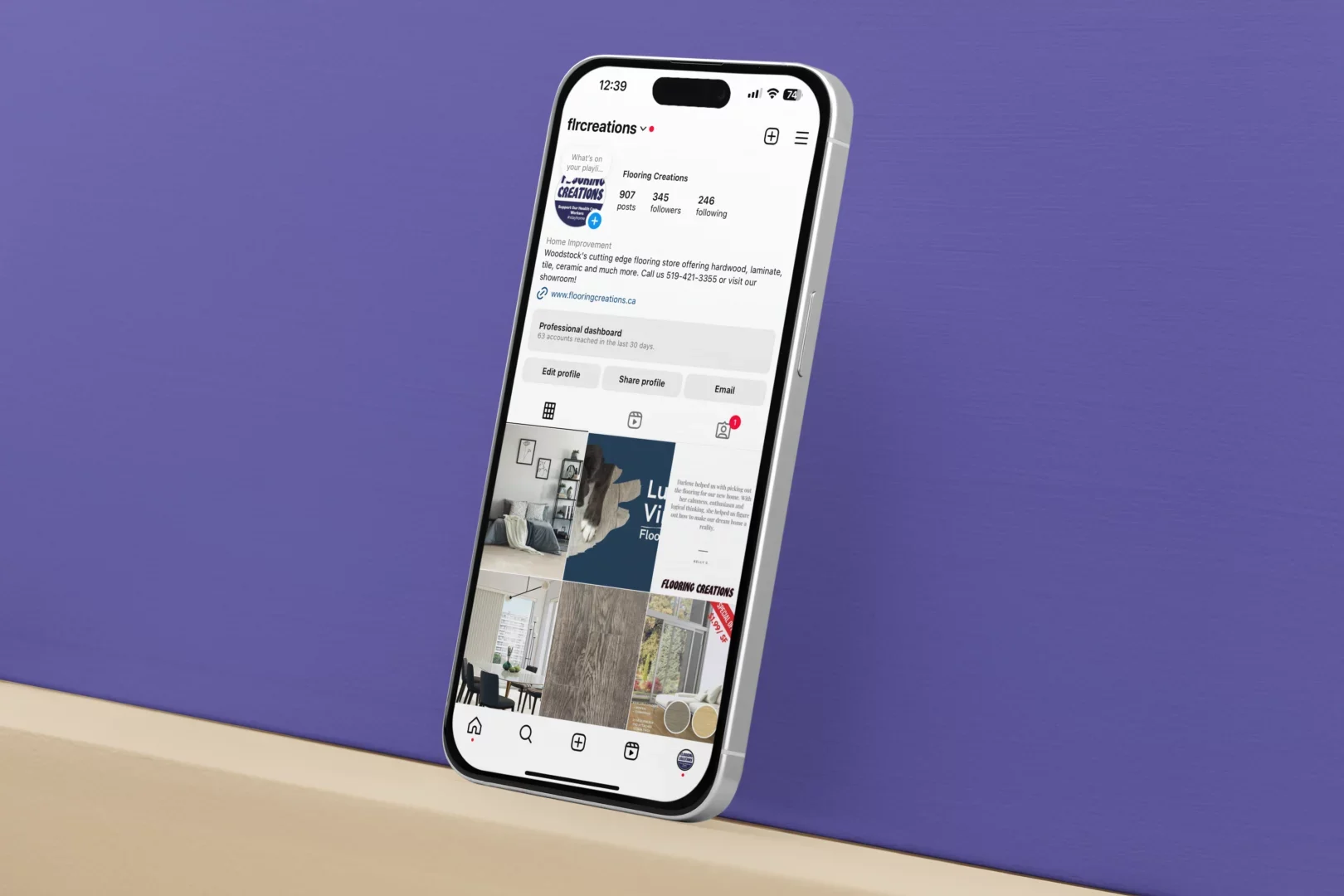
Trades businesses have a natural advantage on Instagram: the work is visual. Before-and-after photos are genuinely compelling. A kitchen reno, a finished deck, a clean panel upgrade — these things photograph well and perform well. People like to dream, right?
Instagram skews younger than Facebook. If you’re trying to reach first-time homeowners in their late 20s and 30s — the people buying houses right now in Brant or Oxford County — Instagram is worth your time.
LinkedIn: skip it for now
Unless you’re actively targeting commercial clients, property managers, or general contractors — LinkedIn isn’t where your residential customers are spending time. Come back to it if and when your business mix shifts.
What to Actually Post
This is the question every trades business eventually asks. And the honest answer is: you already have more content than you think.
Photos of your work
Your work is your portfolio. Every completed job is content. Before the crew leaves, take a few photos — before and after, wide shot, detail shot. Clean, well-lit phone photos are absolutely fine.
A before-and-after bathroom renovation in Woodstock. A newly installed heat pump with a finished basement ceiling in Brantford. A freshly landscaped front yard in Port Dover. These perform well because they’re real, local, and concrete proof of what you can do.
Short “did you know” tips
You are an expert. Your clients are not. Share your expertise in small doses.
“Did you know your sump pump should be tested twice a year?” “Here’s one thing homeowners can do to prevent frozen pipes.” “This is what a well-maintained furnace filter looks like vs. a neglected one.”
Educational content doesn’t give away your work for free. It builds authority. And it puts your name in front of people while they’re thinking about the thing you do.
Behind the scenes
A photo of your truck heading to a job in Tillsonburg. A quick video walking through a tight renovation challenge and how you solved it. Your crew on a Friday afternoon.
People want to do business with people. Behind-the-scenes content is how a faceless business becomes a human one.
Reviews and testimonials
When a client leaves you a five-star Google review, screenshot it and post it. With their name visible — that’s the point. Real people vouching for your work are your best marketing material.
Seasonal Content Is a Natural Fit
This is one of the biggest advantages trades businesses have on social media that most of them don’t use.
Your business is inherently seasonal. Use it.
- March/April: Spring AC checkup reminders, outdoor tap care, deck season prep
- May/June: Landscaping, exterior projects, pool season
- September/October: Furnace tune-up reminders, weatherproofing, pre-winter prep
- November/December: Flooding risk, emergency service availability, holiday promotions
You don’t need to be creative. You just need to show up ahead of the season and remind people what they should be thinking about.
How Often Should You Post?
Two to three times per week is a realistic, sustainable target for most trades businesses. That’s roughly 8–12 posts per month.
You can batch this. Take photos on every job (make it a habit). Sit down once a week for 30 minutes and schedule the week’s posts.
Consistency over perfection. Three posts a week every week beats seven posts one week and then silence for three.
The Budget Question
Organic reach on Facebook — meaning free posts to your page’s followers — is limited. Facebook wants you to pay to reach people.
For a local trades business, a small Facebook ad budget goes a long way. $10–15/day targeted to homeowners in a 30 km radius of primary service area will reach the right people. You don’t need a sophisticated campaign. You need a strong before-and-after photo, two sentences about what you did, and a “call now” button.
Start small. See what works. Increase budget on ads that generate actual calls.
A word on boosts vs. proper ads
The blue “Boost Post” button on Facebook is the easy option. It’s not the best option. Running a proper ad through Facebook Ads Manager gives you more targeting control, better placement options, and cleaner results tracking.
If you’re new to Facebook ads, the Boost button is a fine place to start. Just don’t assume it’s the most powerful tool in the box.
Managing Social Media When You’re Running a Business
Here’s the honest truth: social media for a one-person or small-team trades business is genuinely hard to maintain alongside the actual work.
You can do it yourself if you: batch your content once a week, use a scheduling tool like Meta Business Suite (free), Metricool or Rella and keep a running list of content ideas on your phone.
Or you can outsource it — which makes sense when your time is more valuable than the cost of someone doing it well.
I manage social media for trades and service businesses across Oxford County. Content creation, scheduling, engagement — handled, so you’re not thinking about what to post after a 10-hour day on the job.
FAQ
Is Facebook still relevant for local businesses in small Ontario towns?
Yes. In markets like Woodstock, Ingersoll and Brantford, Facebook is still the dominant platform for local community activity and business referrals. It’s not declining as fast in small Ontario markets as it is in major cities.
Should a trades business have separate Instagram and Facebook pages?
Yes — but you can link them and post to both from the same dashboard. They serve slightly different audiences and it’s worth having a presence on both.
Do I need professional photos for social media?
No. Clean, well-lit phone photos are completely sufficient for most trades businesses. Real photos of real work consistently outperform stock photos.
What should I post if I don’t have any photos from jobs?
Start asking clients for permission to photograph your work going forward. In the meantime: share a review, answer a common question, post a seasonal tip. You can always start with content that doesn’t require job photos.
How do I get more followers?
Worry less about follower count and more about reach and engagement. What matters is whether your content is reaching people in your service area — and whether those people are calling you.
Should I respond to comments and messages on social media?
Yes. Every response is a trust signal. Slow response times to direct messages is a common reason trades businesses lose leads before they even know they had one.
How do I handle negative reviews or comments online?
Calmly and briefly. Acknowledge the concern, offer to talk offline, keep it professional. A well-handled negative review often demonstrates your character more effectively than a string of five-star raves.
Can social media replace word-of-mouth for a trades business?
No — and it shouldn’t try to. Social media amplifies and extends your word-of-mouth reputation. It doesn’t replace the quality of work and relationships that generate referrals in the first place.
The Bottom Line
You don’t need a 10-platform strategy, a viral campaign, or a content team. You need consistent presence on one or two platforms, photos of real work, and a willingness to show up even when business is good.
The trades businesses winning on social media in Brant and Oxford County aren’t doing anything complicated. They’re showing up, sharing their work, and being human about it.
If you’re ready to take social media off your plate so you can focus on the actual work — let’s talk.